
A pylon sign can look deceptively simple from the road: a tall structure, a business name, maybe several tenant panels or an illuminated display. But a commercial pylon is much more than a pole with a box on top.
It is a site-specific structure that has to combine visibility, design, engineering, permitting, foundation work, fabrication, and installation. And because pylon signs are typically substantial commercial projects, understanding what you are actually buying matters before comparing quotes based only on price.
So, when does a pylon make sense, and what should you know before investing in one?
Manufacturing Isn't the Whole Schedule
Imagine a new development requiring 50 signs, including 2 monument signs, over 20 channel-letter signs, and over 20 directory signs. Once everything is approved and ready for production, Saul Signs may be able to manufacture that package in approximately six weeks, depending on the project and the types of signs, thanks to our modern machines and techniques and our team’s experience.
But that’s not where the project begins, or where it ends.
Before manufacturing, there may be site coordination, surveys, design development and approvals, engineering, permitting, landlord or owner reviews, and other project-specific requirements. After production comes installation and, when required, inspections.
For a substantial signage package, we recommend beginning the conversation around six months before the planned opening whenever possible.
That doesn’t mean six months of manufacturing.
It means giving the entire signage project enough room to happen in the right order.
Give Us the Project Information You Already Have
New construction has one major advantage: there is usually documentation available before the property is finished. If you have a site plan, sign criteria, sign schedule, architectural drawings, or other relevant project information, share it with the signage team.
We don’t need documentation simply for the sake of having more paperwork. We need enough information to understand the property, the proposed signage, and how our scope interacts with the rest of the project.
This allows conversations to begin before every physical element of the property is complete.
The Site Survey Is Still Mandatory
Drawings are extremely useful, but they don’t replace what we can verify at the property.
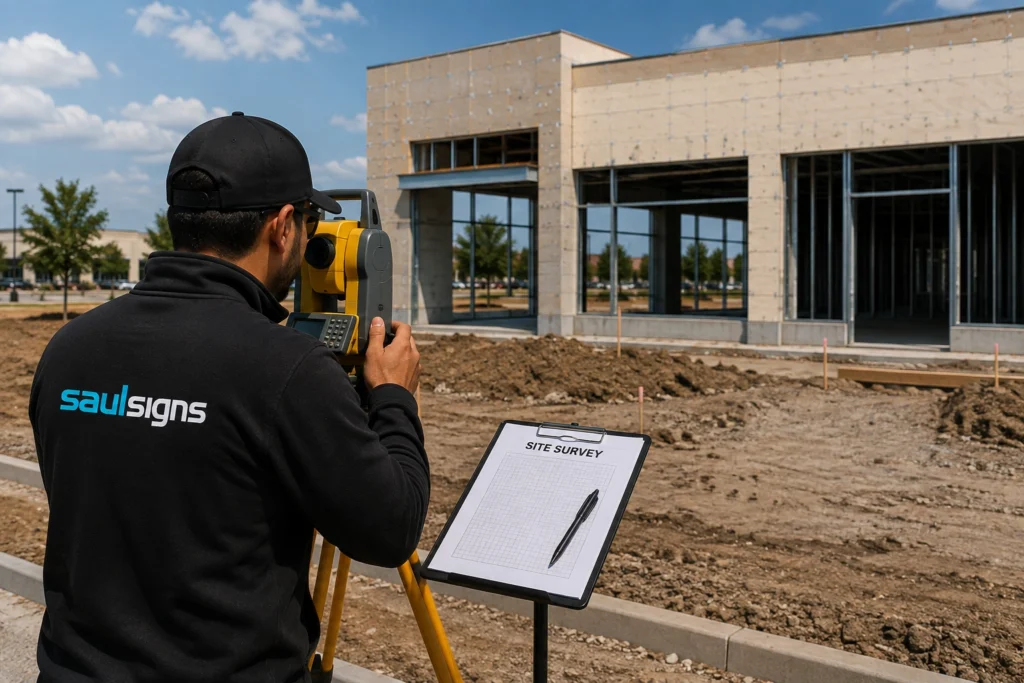
At Saul Signs, the site survey is a mandatory part of the process.
Our sales and installation teams need to understand the actual conditions where the signs will be installed. By the time signage reaches installation, façades and interiors are often already finished. That’s not unusual, and it doesn’t prevent us from doing our job.
It simply makes good communication and accurate site information essential. Drawings tell us what was planned. The site survey tells us what is actually there. We need both perspectives to determine how to proceed.
Signage Has to Coordinate With Other Scopes
A new commercial property involves many contractors, and signage doesn’t exist independently from their work.
For illuminated signage, for example, electrical preparation is typically part of the GC’s or the electrician’s scope. Ideally, the necessary electrical provisions are planned and ready for the signs to be installed.
Freestanding signage creates different requirements. Monument and pylon signs may need substantial foundations, and Saul Signs can execute the complete foundation as part of our scope when required, which is common in these projects.
Façade conditions, access, landscaping, sign locations, electrical preparation, engineering, permitting, and installation must all come together at the right time.
The objective isn’t for one contractor to do everybody else’s job. It’s for the different scopes to work together.
Give the Signage Project Room to Be Done Right
Large commercial signage projects involve many decisions and many individual pieces.
Compressing survey, design, approvals, engineering, permitting, manufacturing, and installation into the final weeks before an opening doesn’t simply create pressure. It creates more opportunities for coordination mistakes.
Starting earlier gives the owner, developer, architect, GC, and signage team time to solve questions while there are still options available.
At Saul Signs, we can coordinate the signage scope from site survey and design through engineering coordination, permitting, fabrication, installation, and required inspections.
So if your new development will need commercial signage, especially a large multi-sign package, don’t wait for the final coat of paint to start the conversation.
Bring signage into the project while there is still time to plan it as part of the property.